Plan your visit to Mercedes-Benz Museum

The Mercedes-Benz Museum is an automotive museum in Stuttgart best known for telling the story of the car from the 1886 Patent Motorwagen to modern Formula 1 and concept vehicles. The visit feels bigger than many people expect because the route winds across seven levels, and the split between the chronological ‘Legends’ path and the themed ‘Collections’ galleries rewards a little planning. The biggest difference between a rushed visit and a great one is knowing when to pause and when to cross between the two strands. This guide covers timing, tickets, routes, and practical day-of tips.

Quick overview: Mercedes-Benz Museum at a glance

If you want the short version before you book, these are the details that change the visit most.

  • When to visit: Tuesday–Sunday, 9am–6pm. Tuesday–Thursday right at 9am is noticeably calmer than weekend late mornings, because you’ll get the elevator ride and top-floor opening galleries before school groups and tour buses spread through the ramps.
  • Getting in: From €10 for standard entry. Guided tour from €16. You can usually buy at the door, but booking ahead makes more sense on summer weekends, public holidays, and special event days when the ticket line is the only real bottleneck.
  • How long to allow: 2–3 hours for most visitors. It stretches closer to 4 hours if you use the audio guide properly and cover both the ‘Legends’ and ‘Collections’ routes instead of sticking to one.
  • What most people miss: The themed ‘Collections’ galleries, the Popemobile, and the mirror under the 300 SL that lets you see engineering details most visitors walk straight past.
  • Is a guide worth it? Yes if you want the brand story, motorsport context, and exhibit shortcuts without reading every panel; otherwise the free audio guide does a good job for less.

🎟️ Tickets for Mercedes-Benz Museum sell out fastest during summer weekends and special event days. Lock in your visit before the time you want is gone. → See ticket options

Jump to what you need

🕒 Where and when to go

Hours, directions, entrances and the best time to arrive

🗓️ How much time do you need?

Visit lengths, suggested routes and how to plan around your time

🎟️ Which ticket is right for you?

Compare all entry options, tours and special experiences

🗺️ Getting around

How the galleries are laid out and the route that makes most sense

🚗 What to see

Patent Motorwagen, Silver Arrows, and the 300 SL Gullwing

♿ Facilities and accessibility

Restrooms, lockers, accessibility details and family services

Where and when to go

How do you get to Mercedes-Benz Museum?

The museum is in Bad Cannstatt, about 5km east of central Stuttgart, beside the Mercedes-Benz campus and close to Mercedes-Benz Arena.

Mercedesstraße 100, 70372 Stuttgart, Germany

→ Open in Google Maps

  • S-Bahn: Neckarpark (Mercedes-Benz) on S1 → 10–13 min walk → Follow the signed path through the Mercedes campus.
  • Bus: Bus 56 to Mercedes-Benz Welt → short walk → Useful if you’re already in Bad Cannstatt.
  • Taxi / rideshare: From Schlossplatz or Hauptbahnhof → 10–15 min → Usually the easiest option if you’re short on time.
  • Car: Museum parking garage P4 → next to the entrance → Budget about €5 for 3 hours.

→ Full getting there guide

Which entrance should you use?

There is one main museum entrance, but your wait depends more on whether you already have a ticket than on the door itself. Most visitors lose time at the ticket counter, not at the exhibit entrance.

  • Pre-booked tickets: For visitors with online tickets or city passes. Expect 0–10 min wait outside peak weekends.
  • On-site ticket counter: For same-day buyers. Expect 10–20 min wait on summer weekends and public holidays.

→ Full entrances guide

When is Mercedes-Benz Museum open?

  • Tuesday–Sunday: 9am–6pm
  • Monday: Closed
  • Last entry: 5:20pm
  • After 4:30pm: Evening Ticket available at a reduced rate

When is it busiest? Late mornings on weekends, school vacation periods, and July–August are the most crowded, especially once tour groups and school classes reach the mid-level galleries.

When should you actually go? Arrive at 9am on a Tuesday, Wednesday, or Thursday if you want the quietest elevator ride, the clearest photos of the spiral atrium, and space around the Patent Motorwagen.

How much time do you need?

Visit typeRouteDurationWalking distanceWhat you get

Highlights only

Elevator to top floor → Patent Motorwagen → early Mercedes icons → Silver Arrows → 300 SL → concept cars → exit

1.5–2 hours

~1.5km

Covers the headline cars and the museum’s main timeline, but you’ll skip most of the themed ‘Collections’ rooms and spend less time on buses, trucks, and special vehicles.

Balanced visit

Top-floor start → full ‘Legends’ route → selected ‘Collections’ galleries → motorsport → postwar icons → concept cars → temporary exhibit if open

2.5–3 hours

~2km

Adds the broader social and design story, including celebrity and utility vehicles, which is where the museum feels richer than a standard car museum.

Full exploration

Top-floor start → complete ‘Legends’ route → full ‘Collections’ route on each level → motorsport interactives → future mobility gallery → temporary exhibits → shop and café

3.5–4.5 hours

~2.5km

Gives you the full museum rather than just the greatest hits, but it’s a long standing-and-walking visit and the final galleries are where tired visitors start to skim.

Which Mercedes-Benz Museum ticket is best for you

Ticket typeWhat's includedBest forPrice range

**Day Ticket**

Museum entry + permanent exhibitions + temporary exhibitions + free audio guide

A full museum visit where you want time to cover both the chronological story and the themed galleries without watching the clock.

Day Ticket (from €10) ↗

**Day Ticket (online purchase)**

Date-specific entry + permanent exhibitions + temporary exhibitions + free audio guide

A busy weekend or holiday visit where you want to skip the ticket counter and go straight to security and the elevator queue.

Online entry (from €10) ↗

**Guided Museum Tour**

Museum entry + official guide + 45–90 minute highlights route

A first visit where you want the major cars, motorsport context, and brand milestones explained without reading every display panel.

Guided tour (from €16) ↗

**StuttCard**

Free museum entry + access to other Stuttgart attractions + public transit on selected pass types

A city break where you’re also planning other museums or using transit enough that one pass is simpler than buying everything separately.

StuttCard (from €20) ↗

**Evening Ticket**

Entry after 4:30pm + permanent exhibitions + temporary exhibitions + free audio guide

A shorter, cheaper visit where you’re happy prioritizing the best-known galleries and skipping a slower, deeper museum day.

Evening Ticket (from €5) ↗

How do you get around Mercedes-Benz Museum?

Museum layout

The museum is sprawling but intuitive once you understand the logic: you take the elevator to the top, then descend through two intertwined paths — the chronological ‘Legends’ route and the themed ‘Collections’ galleries. It is easy to self-navigate, but it is also easy to stay on one strand and miss entire sections on the other.

  • Top floor start: Patent Motorwagen and the birth of the automobile → 15–20 minutes.
  • Legend rooms: The brand story from early cars to postwar icons → 60–90 minutes.
  • Collection galleries: Trucks, buses, service vehicles, celebrity cars, and design themes → 30–45 minutes.
  • Motorsport section: Silver Arrows, racing records, and Formula 1 connections → 20–30 minutes.
  • Future gallery: Concept cars and forward-looking technology → 15–20 minutes.

Suggested route: Follow the ‘Legends’ route first for the timeline, then deliberately cross into the ‘Collections’ galleries on the lower levels; most visitors skip those because the downward spiral makes it too easy to keep moving.

Maps and navigation tools

  • Map: Audio guide app and route materials at the entrance → covers the descending museum circuit and key galleries → get them before you take the elevator.
  • Signage: Wayfinding is good for staying on the main route, but a map genuinely helps if you want to switch between the ‘Legends’ and ‘Collections’ strands without missing rooms.
  • Audio guide / app: Free and multilingual → available as a handset after ticket check and as an app → worth using because it explains why the cars matter, not just what they are.

💡 Pro tip: Decide before the elevator whether you are doing only the ‘Legends’ route or both strands — once you start descending, the building’s flow makes it very easy to skip the themed galleries by accident.
Get the Mercedes-Benz Museum map / audio guide

Where are the masterpieces inside Mercedes-Benz Museum?

Benz Patent Motorwagen at Mercedes-Benz Museum
Silver Arrows gallery at Mercedes-Benz Museum
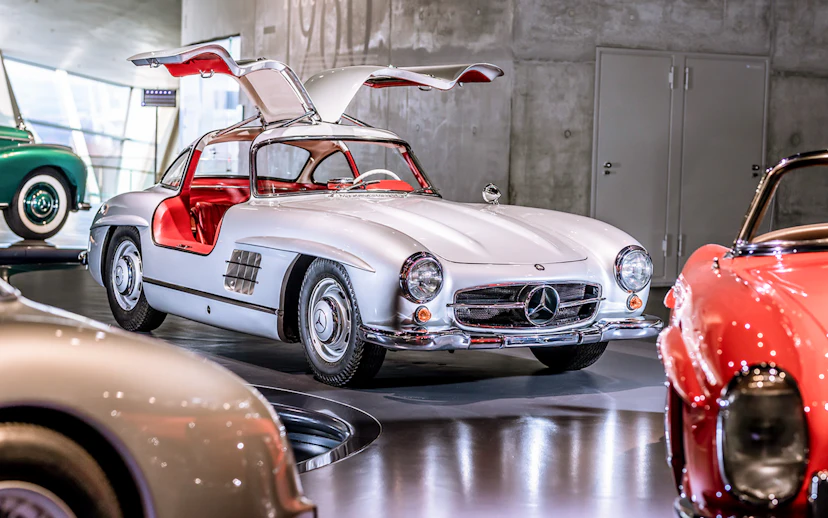
Mercedes-Benz 300 SL Gullwing on display
Grosser Mercedes 770K at the museum
Popemobile in Mercedes-Benz Museum collections
Concept cars in the future mobility gallery
1/6

1886 Benz Patent Motorwagen

Era: 1886, early automotive history

This is the car that makes the whole museum make sense: a three-wheeled machine that marks the start of the automobile story. Most visitors photograph it quickly and move on, but the real payoff is comparing how simple it is against everything that follows down the spiral. The horse placed nearby is the detail people remember later because it makes the technology shift feel immediate, not abstract.

Where to find it: At the very start of the museum route on the top floor, right after the elevator.

Silver Arrows gallery

Era: 1930s and 1950s Grand Prix racing

The Silver Arrows are among the museum’s most dramatic displays, with polished race cars that look fast even when parked. What makes this gallery worth slowing down for is the jump it shows in engineering ambition, from prewar record-breaking machines to postwar racing legends. Many visitors focus only on the cars and miss the archival race footage and driver context that explain why these vehicles mattered beyond speed.

Where to find it: In the ‘Legend 7: Silver Arrows – Races & Records’ section in the later part of the chronological route.

Mercedes-Benz 300 SL ‘Gullwing’

Era: 1954, postwar sports car design

The 300 SL is the museum’s design icon, and it still stops people cold because the proportions and doors feel modern even now. It is easy to treat it as a quick photo stop, but the mirror beneath the car is the detail to notice — it lets you see the engineering underneath that made the famous door shape necessary. That small addition turns a pretty car into a smart exhibit.

Where to find it: In the postwar galleries along the main ‘Legends’ route.

Grosser Mercedes 770K

Era: 1930s luxury and state transport

This enormous prewar limousine shows the scale, weight, and ceremony of Mercedes-Benz at the luxury end of the market. It matters because it reveals a very different side of the brand from the racing and sports-car story most people arrive expecting. What visitors often rush past is the sheer interior and bodywork detail, which makes more sense when you view it as a rolling symbol of power, not just a vintage car.

Where to find it: In the prewar luxury section of the chronological galleries, before the motorsport rooms.

Popemobile and special vehicles

Era: 1980s–1990s special-purpose engineering

The Popemobile is one of the museum’s best surprises because it shows how Mercedes-Benz engineering extends beyond private cars and racing. The glass-enclosed rear section makes it instantly recognizable, but the bigger point is the role these vehicles played in public life, security, and state ceremony. Many visitors miss this whole area because it sits later in the route, when museum fatigue starts to kick in.

Where to find it: In the lower-level themed ‘Collections’ galleries near the end of the visit.

Concept cars and future mobility gallery

Era: Late 20th century to future-facing prototypes

This section closes the museum on the right note because it shifts the story from automotive history into what comes next. The concept cars are visually striking, but what makes them worth your time is how clearly they show Mercedes-Benz testing ideas around autonomy, fuel, and design language. The mistake most visitors make is rushing through here when tired, even though these are some of the easiest exhibits to view from multiple angles.

Where to find it: In the final galleries near the exit, after the main historical route.

Facilities and accessibility

  • 🎒 Cloakroom / lockers: Lockers are available near the entrance, which makes a real difference because carrying bags through seven levels gets tiring fast.
  • 🚻 Restrooms: Restrooms are available in the museum, so use them before the top-floor elevator ride if you want a smoother first hour.
  • 🍽️ Café / restaurant: The on-site café is convenient for coffee, snacks, or lunch, but many visitors find it noticeably pricier than the rest of the experience.
  • 🛍️ Gift shop / merchandise: The large museum shop is downstairs near the exit and is strongest on model cars, branded merchandise, and books.
  • 🪑 Seating / rest areas: There are rest areas through the museum, and using one midway helps if you’re planning the full 3–4 hour version of the visit.
  • 🅿️ Parking: Parking garage P4 sits next to the museum, and around €5 for 3 hours is reasonable if you’re arriving by car.
  • Mobility: The visit uses elevators to the top and broad descending ramps between levels, which makes the main route workable for wheelchair users, though it is still a long 2–3 hour indoor visit.
  • 👁️ Visual impairments: The free multilingual audio guide adds spoken context for the major exhibits, which is especially useful because the museum story relies heavily on labels and chronology.
  • 🧠 Cognitive and sensory needs: Tuesday–Thursday mornings outside summer are the easiest low-stimulation window, while school groups, racing galleries, and peak-season weekends make the museum feel much louder.
  • 👨‍👩‍👧 Families and strollers: Strollers are available on-site, and the ramped route is easier with a pushchair than a stair-heavy museum, but most families still do better with a highlights plan and one break.

The museum works well for children who like cars, racing, or big visual displays, and older kids usually get the most out of the contrast between early vehicles and modern Formula 1 machines.

  • 🕐 Time: 1.5–2 hours is realistic with younger children, and the best priorities are the Patent Motorwagen, Silver Arrows, the 300 SL, and the interactive pit stop area.
  • 🏠 Facilities: Strollers and rest areas make the visit easier with younger children, and the café gives you a practical reset point if attention starts to dip.
  • 💡 Engagement: Turn the visit into a ‘first car to future car’ challenge so children actively compare the 1886 start of the route with the concept cars at the end.
  • 🎒 Logistics: Bring a small bag, start at 9am if you can, and skip the full route if your child is already fading by the motorsport galleries.
  • 📍 After your visit: Mercedes-Benz Arena is a short walk away and works well as a quick post-museum leg-stretcher before heading back into the city.

Rules and restrictions

What you need to know before you go

  • Date-specific tickets can be bought online or on-site, reduced tickets require ID, and children under 14 enter free with an adult.
  • Carry as little as you can because a large bag becomes annoying over seven levels, and lockers near the entrance are the smarter choice.
  • Re-entry is not usually part of the visit flow once you leave, so treat the museum as one continuous 2–3 hour plan rather than a stop you dip in and out of.

Not allowed

  • 🚫 Food and drink belong in the café and lobby areas, not in the exhibit route.
  • 🚬 Smoking and vaping are outdoor matters only, so take a break before entering rather than midway through the visit.
  • 🖐️ Touching vehicles, barriers, or display elements is not allowed because many of the cars on show are original and irreplaceable.

Photography

Photography is generally part of the experience, and most visitors take photos freely across the permanent collection and the spiral atrium. If rules change for a temporary exhibition, the signage in that room is what matters. Flash, tripods, and bulky filming setups are the things most likely to cause problems in tighter galleries or busy periods.

Good to know

  • The free audio guide is worth picking up before the elevator because it frames the top-floor opening galleries far better than the labels alone.
  • The half-price Evening Ticket after 4:30pm is a good deal only if you are happy with highlights, not if you want a slow full-museum visit.

Practical tips

  • Book online for summer weekends and public holidays, but don’t over-plan a quiet weekday visit — the museum usually has enough capacity, and the real gain from pre-booking is skipping the ticket counter rather than securing a hard-to-get slot.
  • Save your attention for the lower half of the visit, not just the first hour — the Silver Arrows, Popemobile, and concept-car galleries are where tired visitors start skimming and miss some of the most memorable sections.
  • Tuesday–Thursday at 9am is the best crowd-management move here because you get the top-floor opening sequence, the Patent Motorwagen, and the spiral architecture before school groups and tour buses spread out through the building.
  • Bring a small bag and comfortable headphones if you have them — the free audio guide is genuinely useful, and a lighter setup makes a noticeable difference over 2–3 hours of ramps and standing.
  • Eat either before you enter or after you finish if you want the cleanest visit flow — the museum café is convenient but expensive, and leaving halfway for food costs more time than it saves.

What else is worth visiting nearby?

Commonly paired: Porsche Museum

Porsche Museum
Distance: 8km — 25 min by car or 45–50 min by transit
Why people combine them: They are Stuttgart’s two headline car museums, and doing both gives you the clearest contrast between Mercedes-Benz’s broad automotive history and Porsche’s tighter sports-car focus.
→ Book / Learn more

Commonly paired: Mercedes-Benz Arena

Mercedes-Benz Arena
Distance: 300m — 5 min walk
Why people combine them: It is on the same campus, so it fits naturally before or after the museum if you want to turn the area into a half-day outing without adding extra transport.
→ Book / Learn more

Also nearby

Wilhelma Zoo & Botanical Garden
Distance: 2km — 5–10 min by taxi or about 25 min on foot
Worth knowing: This is the strongest nearby family add-on if you want to balance a museum visit with outdoor time and something less car-focused.

Schlossplatz and central Stuttgart
Distance: 5km — about 10 min by S-Bahn
Worth knowing: If you only want one more stop after the museum, central Stuttgart is the easiest place for lunch, shopping, and a slower city-center afternoon.

Eat, shop and stay near Mercedes-Benz Museum

  • On-site: The museum café is the easiest option for coffee, cake, or a simple lunch, but most visitors treat it as a convenience stop rather than a destination meal because prices run high for what you get.
  • Better options nearby: Not applicable.
  • 💡 Pro tip: Eat before entry if you want a full 2–3 hour museum visit without breaking the route, and save a sit-down meal for central Stuttgart afterward where you will get more choice and better value.
  • Museum shop: Best for model cars, branded merchandise, books, and souvenirs, and it is located downstairs near the end of the route so you do not need to carry purchases through the galleries.
  • Central Stuttgart shopping: If you want broader retail rather than branded merchandise, head back to Königstraße after your visit because the area around the museum is practical rather than shopping-led.

The museum’s immediate area is convenient rather than atmospheric. It works for a short stay if you have an early museum slot, an arena event, or you are arriving by car, but it is not the most rewarding base for a wider Stuttgart trip. Most visitors are better off sleeping in or near the city center and commuting out.

  • Price point: The area leans functional over boutique, and better-value hotel choice usually opens up once you move back toward central Stuttgart.
  • Best for: Visitors on a one-night stop, drivers who want easy parking, or anyone pairing the museum with Mercedes-Benz Arena.
  • Consider instead: Schlossplatz, Hauptbahnhof, or central Bad Cannstatt are better bases if you want restaurants, evening atmosphere, and easier access to the rest of Stuttgart.

Frequently asked questions about visiting Mercedes-Benz Museum

Most visits take 2–3 hours, though a full sweep of both the ‘Legends’ and ‘Collections’ routes can take 4 hours or more. If you arrive after 4:30pm on the Evening Ticket, you should treat it as a highlights visit rather than a full museum day.

More reads

Mercedes-Benz Museum tickets

Mercedes-Benz Museum highlights

Getting to Mercedes-Benz Museum

Stuttgart travel guide